Any MCP client
Standard Model Context Protocol: works wherever MCP works. See the compatibility matrix →
Any MCP client
Standard Model Context Protocol: works wherever MCP works. See the compatibility matrix →
Zero credentials at rest
Each user’s SWSD token is forwarded per-request, never persisted, never logged.
Profile-scoped tools
Pick triage, agent, knowledge, operations, or full to control which of the 66 tools across 15 categories each deployment exposes.
Operations workflow
The operations profile adds change/release management, ITAM, CMDB lookup, procurement context, risk lookup, work logs, and attachments without enabling every tool.
Write safety controls
Set SWSD_WRITE_MODE to dry-run to preview write payloads or disabled to block write tools while keeping read-only context available.
MCP Apps UI
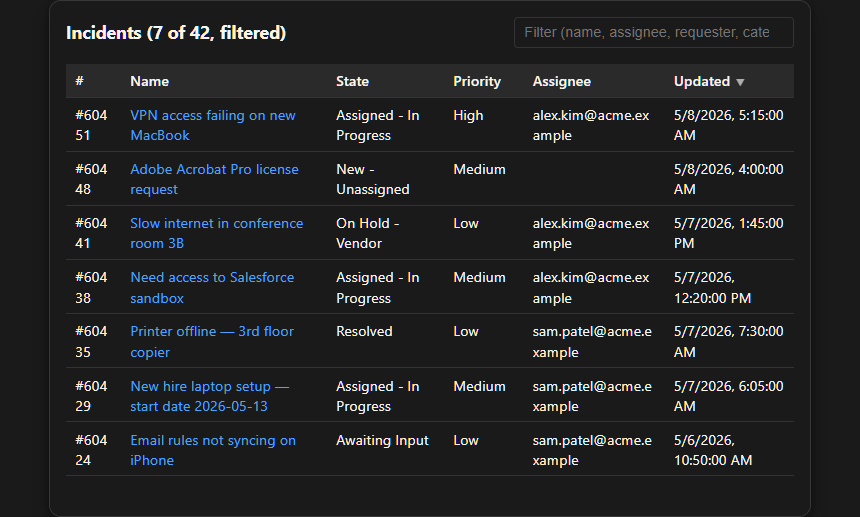
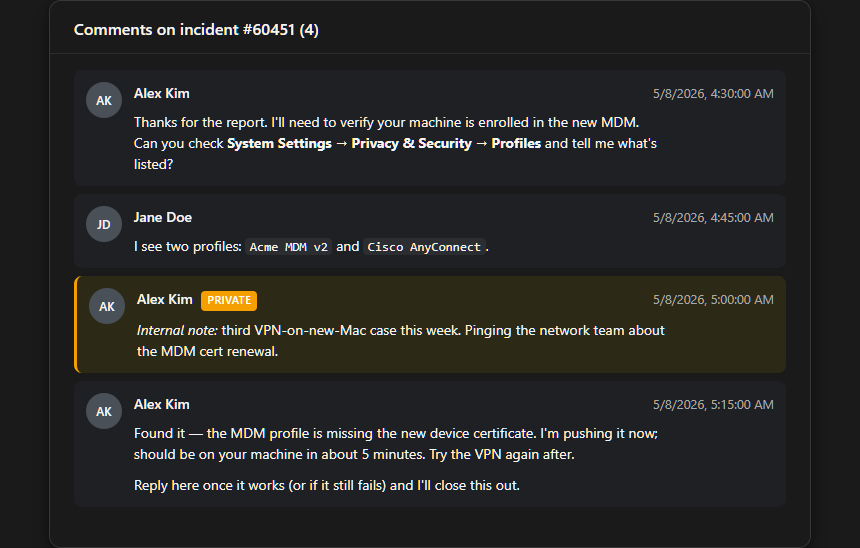
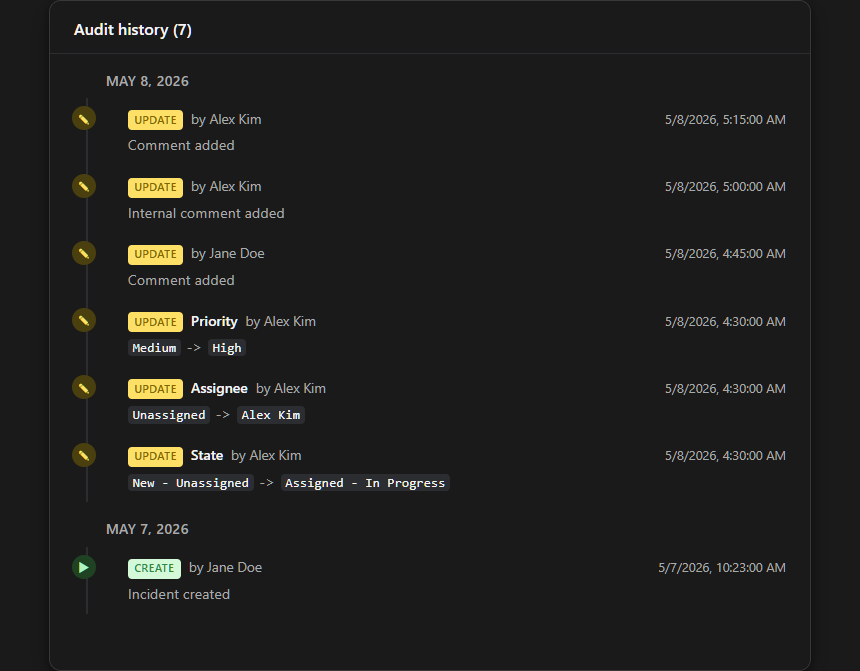
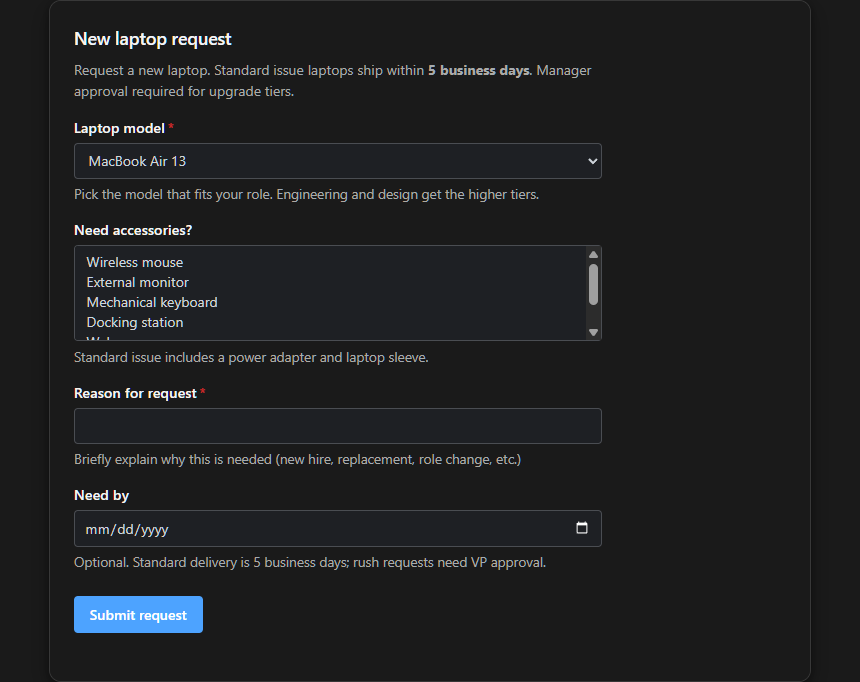
Seven read tools ship rich UI bundles for capable hosts: incident detail, solution detail, incident list, comment thread, audit timeline, catalog-item form, custom-field explorer. Text-only clients are unaffected.
Service Catalog
Browse, inspect, and submit catalog requests with swsd_list_catalog_items, swsd_get_catalog_item, and swsd_create_service_request.
Self-hostable
Stdio for local agents, Streamable HTTP for hosted/Copilot Studio. Docker image and Azure Container Apps recipe included.
Listed on the MCP Registry
Find swsd-mcp in MCP host install pickers via registry.modelcontextprotocol.io.
The seven MCP Apps widgets render rich UI alongside structured tool output. Below: a few captured with synthetic example data (“Acme Corp”). The full gallery + per-widget detail lives on the Widgets reference.